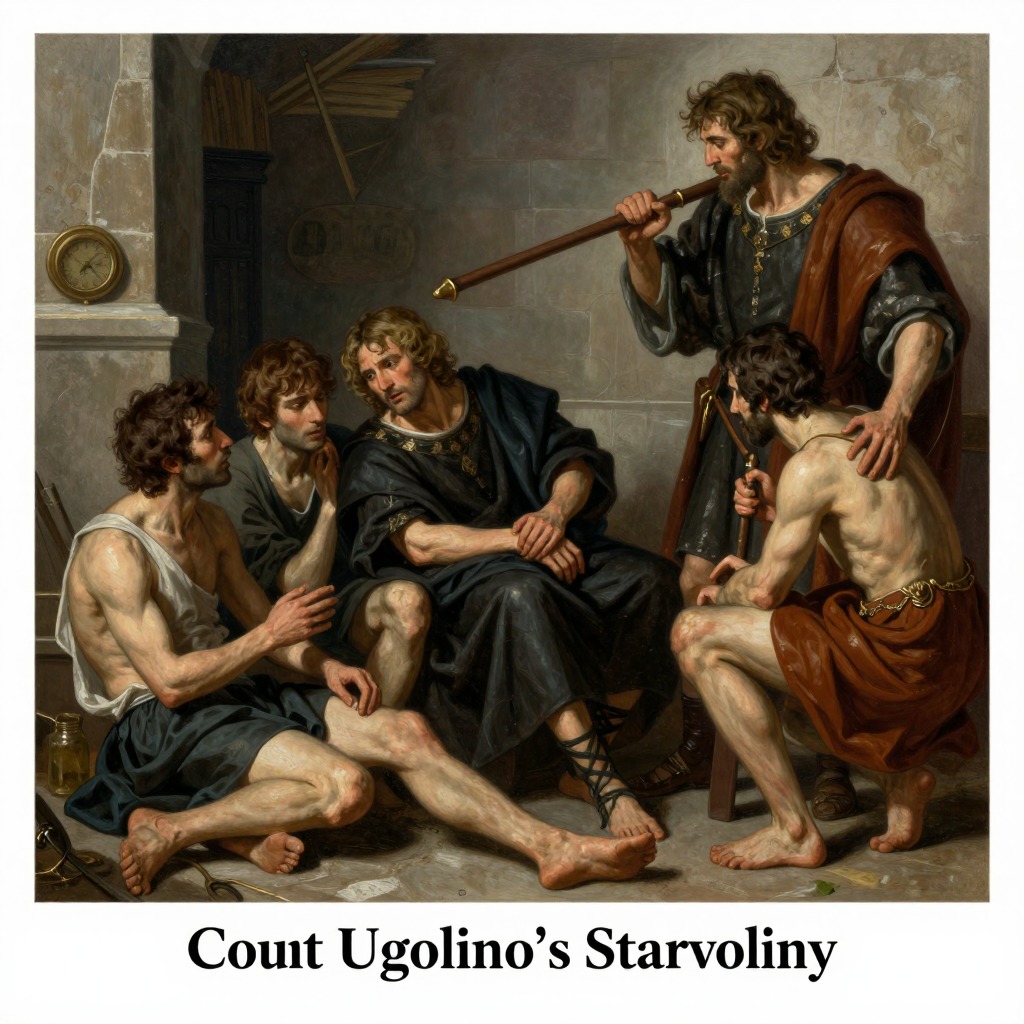
The Story of Count Ugolino
The Story of Count Ugolino is one of the most harrowing episodes in the Inferno, a tale of political betrayal, starvation, and cannibalism that unfolds in the frozen second ring of the Ninth Circle, Antenora, where traitors to their country are punished. Ugolino della Gherardesca, a thirteenth-century Pisan nobleman, recounts how he and his sons and grandsons were imprisoned and starved to death by Archbishop Ruggieri, whom he now eternally gnaws in a grotesque parody of their final days. The episode serves as a devastating indictment of Pisan cruelty and a profound meditation on the limits of human suffering, parental love, and the consuming nature of vengeance.
Background and Betrayal
Count Ugolino was a powerful Ghibelline turned Guelph who ruled Pisa in the late thirteenth century. His political machinations led to a conflict with Archbishop Ruggieri, a man of the church who proved more ruthless than any secular lord. Trusting in Ruggieri’s malicious thoughts, Ugolino was made prisoner and later put to death. The exact circumstances of his betrayal are not detailed in his speech, but the outcome is clear: Ruggieri, having lured Ugolino into a false sense of security, imprisoned him along with his sons and grandsons in a tower that would become known as the Tower of Famine. The tower, a narrow perforation in the mew, bore the title of Famine because of Ugolino’s fate, and others would still be locked up there.
The Dream and the Awakening
After many moons had passed, Ugolino dreamed an evil dream that rent the veil of the future. In the vision, Archbishop Ruggieri appeared as a lord and master, hunting a wolf and its whelps on the mountain that separates Pisa from Lucca. With lean and eager sleuth-hounds, Ruggieri sent Gualandi with Sismondi and Lanfranchi ahead to the front. After a brief course, the father and sons seemed forespent, and with sharp tusks, their flanks were ripped open. When Ugolino awoke before the morrow, he heard his sons moaning in their sleep and asking for bread. The dream had already foretold their doom. The hour drew near when their food used to be brought, and each one was apprehensive through his dream. Then Ugolino heard the locking up of the under door of the horrible tower. Without a word, he gazed into the faces of his sons. He wept not, but within he turned to stone. His sons wept, and his darling little Anselm said, “Thou dost gaze so, father, what doth ail thee?” Still not a tear did Ugolino shed, nor did he answer all of that day nor the night thereafter, until another sun rose on the world.
The Agony of Starvation
When a little glimmer made its way into the dolorous prison, Ugolino saw upon four faces his own very aspect. In agony, he bit both his hands. Thinking he did it from desire of eating, his sons suddenly rose and said, “Father, much less pain ’twill give us if thou do eat of us; thyself didst clothe us with this poor flesh, and do thou strip it off.” Ugolino calmed himself, not to make them more sad. That day and the next they were all silent. On the fourth day, Gaddo threw himself down outstretched before his father’s feet, saying, “My father, why dost thou not help me?” And there he died. As Ugolino saw the three fall one by one between the fifth day and the sixth, he betook himself, already blind, to groping over each. For three days he called them after they were dead. Then hunger did what sorrow could not do.
The Eternal Punishment
Ugolino’s narrative ends with his own death, but his punishment in Hell is far from over. In the frozen lake of Cocytus, within the zone of Antenora reserved for traitors to their country, Ugolino is locked in an eternal, bestial embrace with Archbishop Ruggieri. The count gnaws the skull and other things of the archbishop, his mouth uplifted from his grim repast, wiping it upon the hair of the same head that he behind had wasted. This act of cannibalistic vengeance mirrors the starvation he endured, but it is also a perpetual, futile expression of his hatred. The contrapasso is precise: as Ruggieri starved Ugolino and his children, so Ugolino now consumes Ruggieri, but the consumption brings no satisfaction, only an endless reenactment of his grief and rage.
Dante’s Reaction and the Condemnation of Pisa
Dante, the pilgrim, is so moved by Ugolino’s story that he does not merely record it but intervenes directly. After hearing the tale, he turns to the city of Pisa and delivers a furious apostrophe: “Ah! Pisa, thou opprobrium of the people of the fair land there where the ‘Si’ doth sound, since slow to punish thee thy neighbours are, let the Capraia and Gorgona move, and make a hedge across the mouth of Arno that every person in thee it may drown!” He argues that even if Ugolino had betrayed Pisa’s castles, his sons should not have been put on such a cross, for they were guiltless of any crime. Their youth made Uguccione and Brigata, and the other two, innocent victims of a political vendetta. This outburst transforms the episode from a personal tragedy into a public indictment, making the reader complicit in the judgment against a city that would destroy its own children.
Thematic Significance
The Story of Count Ugolino is a masterclass in the power of narrative to evoke horror and pity. It explores the limits of human endurance, the perversion of parental love under extreme duress, and the consuming nature of vengeance. Ugolino’s final line, “Then hunger did what sorrow could not do,” is a devastating understatement that leaves the reader to imagine the unspeakable. The episode also serves as a critique of political treachery and the cruelty of those in power, embodied by Archbishop Ruggieri, a religious figure who uses his authority for murder. In the broader structure of the Inferno, Ugolino’s story is the most extended and emotionally complex narrative in the Ninth Circle, a fitting climax to Dante’s journey through the depths of human depravity before the final encounter with Lucifer.